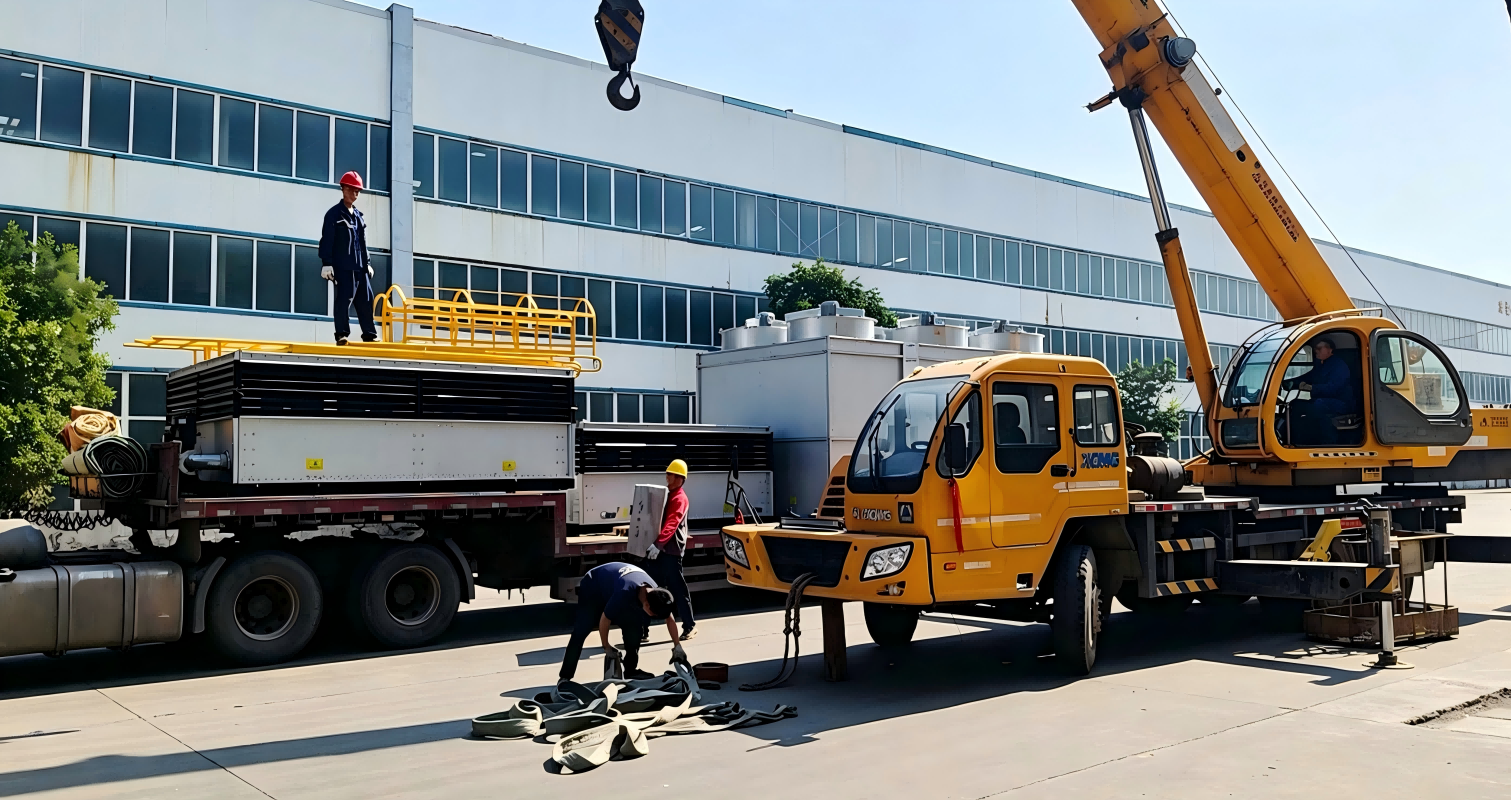
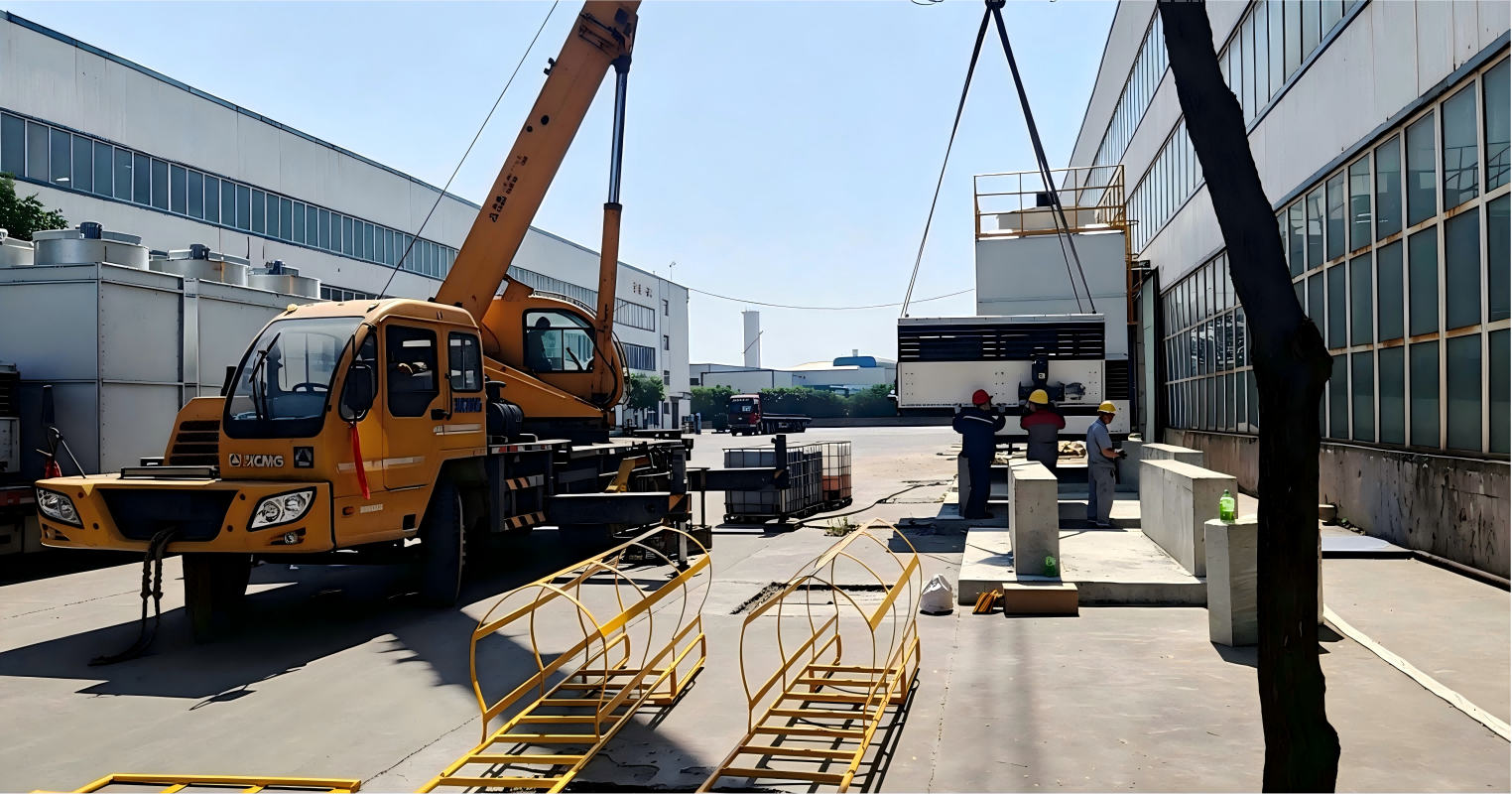
The closed-circuit cooling tower has been successfully delivered to the project site.
All equipment arrived safely, and the unloading operation was completed smoothly under the coordination of the project team and logistics personnel. The successful delivery is another important milestone in the project and sets a strong foundation for the upcoming installation and commissioning activities.
Commissioning Procedure for Closed‑Circuit Cooling Tower
The commissioning of a closed-circuit cooling tower is a critical process to ensure long‑term stable and efficient operation. A complete commissioning procedure typically consists of five core stages: Pre‑Commissioning Preparation, Individual Equipment Trial Run, System Integrated Test, Performance Testing & Data Recording, and Final Wrap‑up.
1️⃣ Pre‑Commissioning Preparation – General Inspection & Cleaning
Before starting the equipment, a thorough inspection must be completed to prevent issues later.
-
Documentation & Site Verification
Verify that the equipment model and specifications comply with the design requirements. Check the installation position, foundation stability, and vibration isolation measures. Clean the interior of the unit to ensure no debris remains. -
System Inspection
Confirm that all piping connections are correct and that valves are in the proper operating position. Manually rotate the fan and pump shafts to ensure there is no binding or abnormal resistance. -
Piping Cleaning
Before commissioning, the circulating piping system must undergo physical cleaning and chemical cleaning to remove welding slag, rust, oil, and other debris, preventing damage to the equipment. -
Electrical System Check
Use a multimeter to check wiring and a megohmmeter to measure insulation resistance, ensuring there are no short circuits and that grounding is reliable. Verify that the supply voltage is 380V ± 10%. Check that all sensors and controllers are functioning properly. -
Filling & Air Bleeding
Slowly fill the system with water and bleed air through the air release valves. For the cooling coil of the closed‑circuit cooling tower, after filling with the medium, open the vent valve at the coil inlet to exhaust any trapped air.
2️⃣ Individual Equipment Trial Run – Verify Standalone Function
Test each major component independently before system integration to verify proper operation.
-
Pump Trial Run
Jog‑start the pump to check rotation direction. If reversed, swap any two power supply phases. After start‑up, observe whether water pressure is stable and check for abnormal noise or vibration. For large pumps (≥ 30 kW), close the discharge valve before starting. -
Fan Trial Run
Start the fan and check rotation direction. Confirm there is no abnormal noise or excessive vibration. It is recommended to run the fan for 1 hour, then stop and check the motor for abnormal heating.
3️⃣ System Integrated Test – System Coordination Verification
After individual equipment tests are passed, perform a full system integration test to verify coordinated operation.
-
Start‑up Sequence
Start the fan first, then the spray pump, and finally the main circulating pump. Observe whether the spray water evenly covers the coil surface, and check that the water level in the basin remains stable. -
Parameter Check
Verify that the running current of the fan and pumps is within the rated range. Ensure there is no abnormal noise or vibration, and that motor temperature rise is normal without excessive heating.
4️⃣ Performance Testing & Data Recording
After stable operation, carry out comprehensive performance testing and data logging.
-
Heat Exchange Efficiency Test
Measure inlet/outlet water temperatures, ambient temperature, humidity, and other parameters to calculate whether the actual heat exchange efficiency meets the design requirements. -
Power Consumption & Noise Test
Record the operating power of the fan, pumps, and other main equipment. The cooling tower noise level should meet project specifications (e.g., ≤ 65 dBA at 1 m distance). -
Data Recording
It is recommended that after 1 hour of normal operation, key parameters such as voltage, current, water pressure, and temperature be recorded multiple times for documentation and future reference.
5️⃣ Final Wrap‑up & Operation Notes
-
Documentation & Training
Organize and archive all commissioning records and as‑built documents. Provide training to operators on safe operating procedures. -
Shutdown Sequence
When shutting down, first stop the heat source, then allow the circulating pump to continue running for a period to remove residual heat before stopping the cooling tower. -
Winter Freeze Protection
When the ambient temperature drops below 0°C, proper freeze protection measures must be taken to prevent the equipment from freezing and cracking. -
Routine Maintenance
Regularly flush the fill media. It is recommended to change the cooling water and flush the basin every 15 days. Ensure that bearings, gears, and other rotating parts are properly lubricated.